
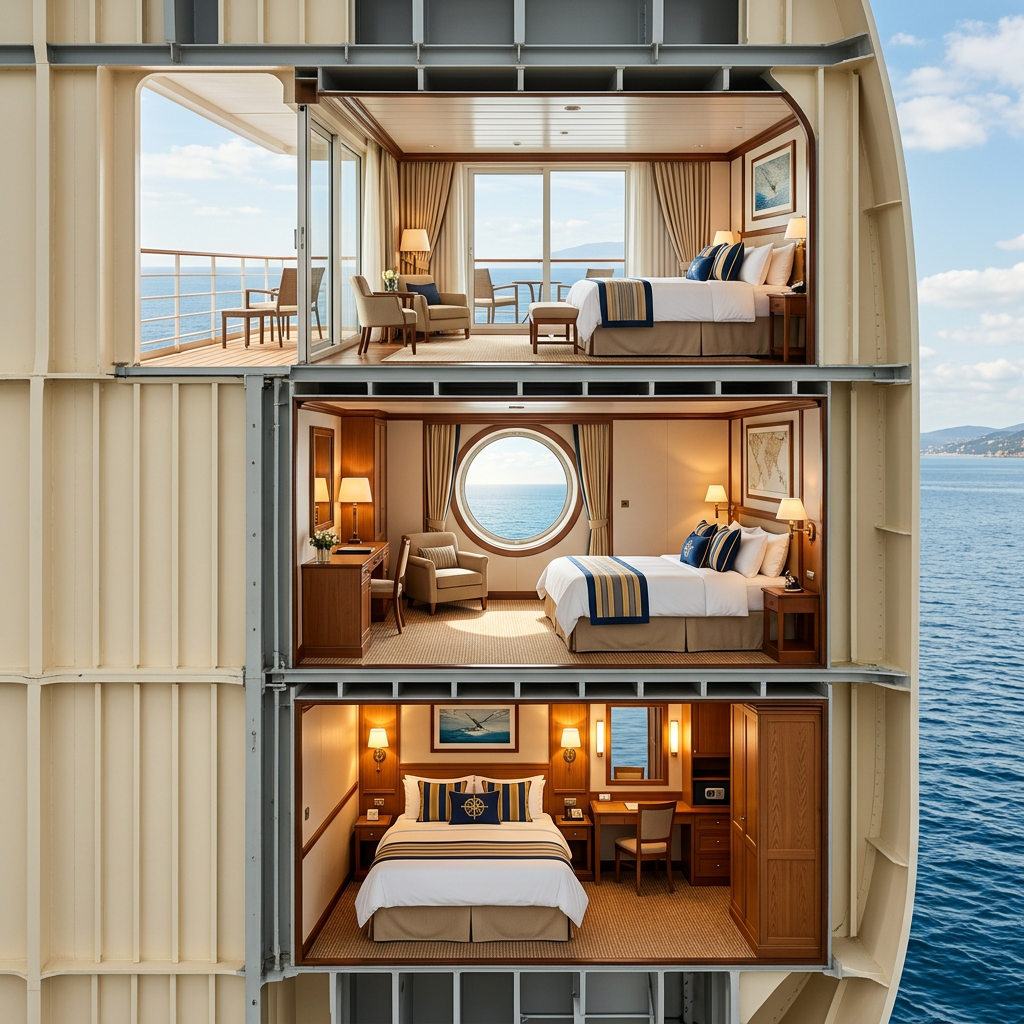
The right cruise cabin depends on who is traveling, your vacation budget, how much time you expect to spend in your room, your need for daylight or outdoor space, and whether location, accessibility, or motion sensitivity affects your comfort. Start by comparing interior, oceanview, balcony, and suite accommodations, then review the exact cabin’s layout and position on your ship. A higher-priced room is not automatically a better fit: the goal is comfort that supports the way you actually want to cruise. Cruise lines offer different room configurations, so compare the specific ship and category rather than relying on a category name alone.

Welcome to Tuesday Travel Smarts with Voyage JTravels! 🚢 Today, we are making one of the biggest first-cruise decisions feel a little less complicated.
Choosing your first cruise cabin can feel surprisingly personal. You might picture morning coffee with an ocean view, a quiet place to recharge after exploring a port, or simply a comfortable room that leaves more of your vacation budget available for experiences.
Those are all valid priorities.
Instead of asking, “What is the best cabin on a cruise ship?” begin with a more useful question: “Which cabin will make this particular vacation work better for me?”
This first-time cruiser’s guide walks you through cruise cabin types, ship locations, balcony considerations, guarantee bookings, family arrangements, accessibility questions, and practical packing decisions—without assuming that everyone needs the same upgrade.
How to Choose a Cruise Cabin: Start With Your Travel Style
Before comparing deck numbers or scrolling through room photographs, decide what you need your cabin to do.
Will it mainly be a place to shower, change, and sleep? Or will it be part of the vacation itself—a place to read, enjoy private downtime, or retreat while someone else gets ready?
Try answering these questions before looking at cabin prices:
- Who will share the room?
- Does anyone need daylight to feel comfortable?
- Would private outdoor space genuinely get used?
- How important is a quiet location?
- Does anyone have mobility, sensory, or other accessibility requirements?
- Would you rather spend more on the room or preserve funds for other parts of the trip?
- Are you comfortable letting the cruise line choose your cabin location?
Your answers become a practical filter.
For example, a couple planning to spend most of each day enjoying the ship and ports might prioritize a well-located interior cabin. Another couple might value a balcony because sitting outside together is part of their ideal vacation.
Neither choice is inherently more sophisticated. The better choice is the one that matches expectations before money changes hands.
Voyage JTravels approaches cabin selection as part of the whole itinerary: your room, sailing, transportation, pre-cruise arrangements, and spending priorities should work together rather than compete for attention.
Cruise Cabin Types Explained: Interior vs. Oceanview vs. Balcony vs. Suite
Cruise lines use different names and category codes, but these four accommodation types provide a useful starting point. Within each type, capacity, layout, view, and amenities can vary by ship. Official accommodation pages and the applicable deck plan should guide the final comparison.
| Cruise cabin type | Main feature to evaluate | Who might consider it | What to verify |
|---|
| Cruise cabin type | Main feature to evaluate | Who might consider it | What to verify |
|---|---|---|---|
| Interior | Enclosed accommodation without a conventional exterior window | Travelers prioritizing the ship, itinerary, and overall budget | Whether any advertised “view” is a screen or an interior-facing feature |
| Oceanview | An exterior window or porthole rather than a private balcony | Travelers who want daylight without necessarily needing outdoor space | Window style, obstruction, and exact room layout |
| Balcony | A room with access to its own balcony area | Travelers who expect to use private outdoor space | Whether it faces the ocean or an interior neighborhood |
| Suite | A category marketed with additional space, features, or benefits | Travelers seeking a particular layout or upgraded experience | Exact floor plan, sleeping arrangements, and included benefits |
These are comparison categories, not universal specifications. One ship’s balcony room may have a very different layout from another’s, and the word “suite” does not establish a standard list of benefits across cruise lines.
Interior Cruise Cabins: A Practical Starting Point for Active Travelers
An interior cabin deserves consideration when your priority is the vacation beyond the room.
Perhaps your ideal day includes breakfast, a shore excursion, an afternoon activity, dinner, and a show. In that situation, private outdoor space might not be especially important to you.
The key question is whether you will feel comfortable without a conventional exterior window. Do not dismiss that preference as unimportant simply because you expect to be busy.
Before choosing an interior room, ask yourself:
- Have I been comfortable sleeping in windowless accommodations before?
- Do I want natural light while getting ready?
- Will I spend quiet afternoons in the cabin?
- Am I choosing this category intentionally, or only because it appears first in a search?
An interior cabin can be a thoughtful choice. It should not feel like a compromise you never agreed to make.
Also read the actual description. Cruise room terminology includes variations that may feature an interior-facing view or a screen rather than a conventional outside view; category details matter more than an appealing photograph.
Oceanview Cruise Cabins: Daylight Without a Private Balcony
An oceanview cabin is worth comparing when a window matters more to you than outdoor seating.
This can be a useful middle ground for travelers who want a visual connection to the outside but do not expect to spend much time sitting on a private balcony.
However, “oceanview” is not a promise that every room has the same window size or the same uninterrupted outlook. Review the exact category and any obstruction disclosure rather than treating all windowed cabins as equivalent. Cruise lines distinguish room types and view conditions in their accommodation information.
Ask what you are actually buying: daylight, a particular view, a particular room arrangement, or some combination of those features.
That small distinction helps prevent a common disappointment—booking a category for one reason while assuming it includes something else.
Balcony Cruise Cabins: Private Outdoor Space With Important Differences
A balcony can be a meaningful part of your cruise experience if you expect to use it.
Think about your habits at home and on other vacations. Do you enjoy sitting outside with a book? Would you choose quiet time over another activity? Does a private place to pause make a trip feel more restorative?
If yes, a balcony deserves a place on your shortlist.
But read beyond the word “balcony.” Royal Caribbean states that certain guarantee balcony assignments on Oasis and Icon Class ships may be neighborhood-view balconies rather than the ocean-facing balcony a traveler might have imagined. It also warns that assigned rooms may have obstructed views.
That makes these essential questions:
- Does the balcony face the ocean or an interior area?
- Is any obstruction disclosed?
- What is the balcony layout?
- What can other guests overlook?
- Does the room’s location suit your preferred routine?
Buy the balcony experience described in the booking—not the one you mentally added to it.
Cruise Suites: Compare the Actual Benefits, Not Just the Name
Suites deserve a careful, item-by-item comparison.
Start with the floor plan. Does the suite provide the separation you want, or simply more space within one room? If several people are sharing, where will each person sleep?
Next, review the benefits attached to that exact category. Norwegian, for example, distinguishes its Club Balcony Suite and balcony accommodations from other suite products. Category names alone do not establish identical privileges.
For a first-time cruiser, a useful approach is to list the features you would genuinely use:
- Additional living space.
- A particular bathroom arrangement.
- More privacy between sleeping areas.
- Specific dining or service benefits.
- A balcony configuration that suits your plans.
Then compare the applicable category against that list. A suite becomes a considered purchase when the extra features solve real needs—not simply because it sits at the top of the results page.
Best Cruise Cabin Location: How to Read a Ship’s Deck Plan
Once you have a preferred room type, location becomes the next decision.
A deck plan is a map of the ship’s accommodation and public areas. Use the official plan for your actual vessel rather than assuming a sister ship or another ship in the fleet has the same arrangement. Royal Caribbean publishes ship-specific deck plans for this purpose.
Three directional terms will help:
- Forward: toward the front of the ship.
- Midship: around the middle of the ship.
- Aft: toward the rear of the ship.
Start with your potential cabin, then inspect the surrounding area.
Look at the same deck, the deck above, and the deck below. Identify public venues, accommodation corridors, stairs, elevators, and the routes you are likely to use.
Rather than searching for a universally “perfect” deck, ask:
- Is this location convenient for the places I expect to visit?
- Does the surrounding layout raise questions about activity or noise?
- Is the route manageable for everyone traveling?
- Am I comfortable with the distance from key facilities?
- Have I checked the exact cabin rather than only its general category?
A room can have an appealing photograph and still be a poor match for your daily routine. The deck plan helps connect the room to the vacation you will actually experience.
Best Cabin for Seasickness: Why Midship and Lower Decks Matter
If motion sensitivity is part of your decision, a cabin near midship on a lower passenger deck is generally a sensible starting point. This position can reduce the movement you feel compared with locations farther toward the ends of the ship or higher above the water. The best available option still depends on the vessel’s layout and conditions at sea.
This is not a promise that you will avoid seasickness.
A lower, centrally located cabin is a location strategy—not a medical treatment or a weather guarantee. Do not assume that a balcony, a suite, or a larger ship automatically removes the possibility of discomfort.
For travelers with a history of motion sickness, keep the planning questions separate:
- Cabin question: Which available location best supports my comfort?
- Medical question: What prevention or treatment is appropriate for me?
Take the second question to a licensed healthcare professional or pharmacist, especially when medications, existing conditions, pregnancy, or children are involved.
Also avoid choosing an exact deck number based on an internet rule such as “Deck 7 is always best.” Ship layouts vary. Review the actual deck plan and compare where each available cabin sits in relation to the middle of the vessel.
Quiet Cruise Cabins: What to Check Before You Book
If sleep and quiet downtime are priorities, turn those preferences into specific booking questions.
Use the deck plan to investigate what surrounds the room. A location beneath or beside an active public area deserves a closer look, especially if your preferred sleeping hours differ from the ship’s activity schedule. Official deck plans identify the venues and accommodations you need to compare.
This does not mean every room near a public area will be noisy. Nor does it mean a room surrounded by other cabins will be silent.
Instead, use the layout to ask better questions:
- What operates directly above this room?
- Is there a venue nearby with evening entertainment?
- Is this close to a heavily used gathering area?
- Does the room connect internally to another cabin?
- Is the convenience of this location more important to me than being farther from activity?
Be cautious with broad “cabins to avoid” lists that do not identify the specific ship, cabin category, or reason for the warning.
A location that one guest dislikes may be convenient for another. Your goal is not to eliminate every possible sound; it is to avoid obvious mismatches between your expectations and the room’s surroundings.
Is a Balcony Worth It on a Cruise? Use This Simple Decision Test
A balcony is worth considering when you can explain how you expect to use it.
Try finishing this sentence:
“I want a balcony because I plan to…”
Your answer might be to read outside, enjoy quiet conversation, take breaks between activities, or spend part of each sea day in a private outdoor setting.
Now compare that answer with your actual itinerary and habits.
If you tend to leave the room early and return only to sleep, another category might serve you just as well. If private downtime is part of the reason you are taking a vacation, the balcony may deserve more priority.
Consider three practical tests:
The Use Test
Can you picture using the balcony regularly, rather than simply liking the idea of having one?
The Trade-Off Test
What would you give up elsewhere in the trip to pay for it? Evaluate the complete vacation budget, not only the room upgrade.
The Expectation Test
Have you confirmed the direction, view, and category? A balcony overlooking an interior neighborhood is not the same product as an ocean-facing balcony.
There is no need to justify your preference to another traveler. The objective is an informed decision that feels right before departure.
Obstructed-View Cruise Cabins: Read the Description Carefully
An obstructed-view cabin should prompt questions, not an automatic rejection.
The important issue is whether the actual view meets your expectations. Royal Caribbean explicitly notes that guarantee cabin assignments may include obstructed views.
Before booking, request clarification about:
- Whether an obstruction is disclosed.
- What the cruise line says causes it.
- Whether the description applies to the window, balcony, or general outlook.
- Whether the room’s appeal still makes sense for your priorities.
If your main goal is daylight, your evaluation may differ from someone booking specifically for wide-open views.
Where photographs are available, prioritize images clearly associated with the exact room or category. Treat unverified social media images as questions to investigate rather than proof of what your own booking includes.
A thoughtful cabin comparison is less about labeling rooms “good” or “bad” and more about understanding what you are agreeing to purchase.
Guarantee Cruise Cabins vs. Choosing Your Own Stateroom
A guarantee booking can look appealing, but it involves a different level of control.
Royal Caribbean describes its guarantee, or “We Pick,” option as booking a guaranteed category type while allowing the cruise line to assign the exact room, number, and location. Assignment can occur as late as check-in at the port.
The same policy explains that:
- Assigned rooms may have obstructed views.
- Traveling parties may not be located near one another.
- Certain balcony guarantees may result in a neighborhood-view balcony.
The practical question is not simply, “Will this cost less?”
Ask, “Would I be satisfied with the possible assignments permitted by this booking?”
A guarantee may be worth comparing when you are genuinely flexible. It deserves more caution when you need a particular location, want nearby rooms, or care strongly about a specific view.
Read the terms for your own cruise line and fare. Do not assume another company uses the same assignment rules.
And never build your vacation expectations around receiving a complimentary upgrade. Book an option you would be comfortable keeping.
Best Cruise Cabins for Families and Friends Traveling Together
When several people share a cabin, the room’s maximum occupancy is only the beginning of the conversation.
You also need to understand how that occupancy works.
Ask to see the sleeping configuration and consider the room in both daytime and nighttime use. Where does each person sleep? What changes when additional beds are in use? Does everyone have the privacy they expect?
Norwegian advertises connecting balcony accommodations as an option for groups, illustrating why a comparison between one room and multiple connected rooms can be useful. Availability and layout depend on the ship and category.
For families and friends, compare:
- One cabin that accommodates the entire party.
- Two nearby cabins.
- Confirmed connecting cabins.
- A suite with a suitable floor plan.
“Nearby” and “connecting” are not interchangeable. If an internal connecting door is important, have that feature confirmed rather than assuming adjacent room numbers provide it.
Before paying a deposit, also confirm the cruise line’s rules about minors, adult placement, and permitted room assignments. These are provider-specific requirements, not details to resolve after booking.
The best arrangement is the one everyone understands—not the one that merely fits the head count.
Solo Cruise Cabins: Compare the Total Price for One Traveler
Solo travelers should search using the actual number of guests from the beginning.
Norwegian offers solo accommodation options that include inside, oceanview, balcony, and Studio categories. Its solo offerings demonstrate that traveling alone does not necessarily limit you to one type of room. Availability and associated facilities vary by ship and accommodation.
Compare the complete price for one person rather than treating a headline double-occupancy rate as your final cost.
Then apply the same comfort questions any other traveler would ask:
- Do I want daylight?
- Will I use a balcony?
- How much room do I need?
- Does the location suit my routine?
- Are any advertised solo facilities available with this exact booking?
Be particularly careful with lounge access claims. Check the applicable ship and category rather than assuming all solo products include identical access. Norwegian’s published solo information includes ship- and accommodation-specific qualifications.
Your cabin should support independence and comfort, whether you plan to socialize frequently or enjoy a more self-directed vacation.
Accessible Cruise Cabins: Confirm Features Before Committing
Accessibility requirements should lead the cabin search, not be added after you have chosen a room.
A larger cabin is not automatically an accessible cabin.
Royal Caribbean identifies designated accessible staterooms with specific maneuvering features. Its accessibility information also explains that assistive devices must be stored and recharged inside the stateroom rather than in corridors or elevator lobbies.
Depending on your needs, request confirmation of:
- Stateroom and bathroom doorway clearances.
- Bathroom configuration.
- Turning and transfer space.
- Bed arrangement.
- Balcony access and any threshold considerations.
- Storage and charging arrangements for mobility equipment.
- Available hearing or visual accessibility features.
Give the cruise line accurate device dimensions and functional requirements. Ask its accessibility team to verify suitability for the exact ship and cabin.
Do not rely solely on a room photograph, a generic square-footage figure, or another traveler’s experience. Those may not address the features that matter to you.
Voyage JTravels can help organize the questions and coordinate the planning conversation, while the cruise line confirms its facilities and any required documentation.
First Caribbean Cruise Planning: Match the Cabin to the Sailing
For this guide’s primary trip-planning example, consider a Caribbean cruise departing from a U.S. port.
The cabin decision should follow the sailing decision—not replace it. Start with the itinerary, departure arrangements, length, and overall vacation priorities, then compare rooms on the ships that fit.
For a first cruise, consider a five- to seven-night sailing as a planning starting point if your schedule allows. That is a suggested comparison range, not a rule: the right length depends on your time, budget, and comfort with trying a cruise vacation.
Ask yourself what you are trying to learn from this first experience:
- Whether cruising suits your travel style.
- Whether you enjoy sea days.
- Whether private cabin time matters.
- Whether you prefer a busy schedule or a slower pace.
The cabin becomes easier to choose when you understand the kind of week you want.
A port-heavy itinerary may lead you to prioritize different room features than a sailing where you intentionally plan substantial onboard downtime. That is a personal planning distinction, not a reason to assume one cabin category always belongs with one itinerary.
Best Time for a Caribbean Cruise: Weather, Crowds, and Value Questions
There is no single best departure date for every first-time cruiser.
Compare your available dates against school breaks, holidays, flight options, and the actual sailings under consideration. Rather than assuming a particular month will be cheapest or quietest, review the complete trip for your chosen dates.
Weather also belongs in the discussion. The Atlantic hurricane season runs from June 1 through November 30 and includes the Caribbean basin. NOAA notes that tropical cyclones can also occur outside those official dates.
That does not mean every sailing during hurricane season encounters a storm. It does mean you should understand the provider’s terms, monitor official information, and avoid treating any season as a guarantee of calm conditions.
If travel protection is part of your plan, read the actual policy and ask a licensed insurance professional or the provider about coverage questions. Do not assume a weather-related concern automatically qualifies for reimbursement.
Cruise Cabin Budget: Compare the Whole Vacation, Not Just the Room
Cabin value is easier to judge when you compare equivalent trips.
Use the same ship, departure date, guest count, and booking conditions whenever possible. Otherwise, you may be comparing more than a room upgrade without realizing it.
Build a planning worksheet that includes:
- The applicable cruise total.
- Transportation to and from the departure port.
- Any pre-cruise accommodation.
- Transfers and parking, if relevant.
- Planned onboard purchases.
- Shore experiences.
- Any gratuities or service charges not already included.
- Travel protection, if selected.
Confirm each item with the appropriate provider. Inclusions, payment schedules, cancellation terms, and optional purchases can differ.
Then ask a useful question: “Does this cabin leave enough room in the budget for the vacation I want around it?”
A room upgrade may be worthwhile. So may keeping your original cabin and choosing a meaningful shore experience. Neither outcome is a failure to travel well.
Curated planning helps make these trade-offs visible before they become stressful.
Cruise Cabin Packing Tips: Bring What Supports Your Routine
Before buying cabin accessories, check what your cruise line provides and permits.
Royal Caribbean, for example, maintains a prohibited-items policy and notes that items can be restricted for safety and operational reasons. An accessory marketed online as a “cruise essential” is not automatically permitted onboard your sailing.
Build your packing list around practical needs:
- A compact toiletry organizer.
- A small laundry bag.
- Sleepwear and layers suited to your preferences.
- Earplugs or a sleep mask if you normally use them.
- Chargers permitted by your cruise line.
- Essential personal items you want within easy reach.
For embarkation day, consider keeping medications, documents, valuables, and the items you need immediately with you rather than placing everything in checked luggage.
Do not purchase electrical accessories, heating appliances, or other equipment without checking the current provider rules. If you require medical equipment, coordinate directly with the cruise line’s accessibility or special-needs team.
The objective is a functional room, not a suitcase full of products someone else declared necessary.
Cruise Cabin Mistakes to Avoid Before Your First Sailing
A few small checks can prevent a large gap between expectation and reality.
Booking From the Photograph Alone
Use photographs as a starting point. Confirm the category description, occupancy, floor plan, view, and location. Official accommodation information and deck plans provide the details needed to connect the image with the actual booking.
Assuming Every Balcony Faces the Ocean
Some balcony categories overlook interior neighborhoods. Verify the direction and category before paying.
Choosing a Guarantee When Location Is Essential
If proximity, view, or a particular area matters, understand exactly what control you give up with a guarantee fare.
Forgetting to Discuss Sleeping Arrangements
A room that accommodates your group still needs to work for your group. Review who sleeps where before booking.
Expecting a Universal “Best Deck”
The useful answer depends on the ship, available rooms, and your priorities. Motion considerations and daily convenience may point toward different options.
Treating an Upgrade as a Substitute for Planning
More expensive accommodation does not resolve an unsuitable itinerary, an unrealistic budget, or unclear expectations.
Good planning connects those decisions instead of asking the cabin to do all the work.
A Less-Obvious Cruise Planning Tip: Design One Unhurried Port Morning
Here is an insider-feeling approach that does not require buying the most expensive room: plan one port visit around a single meaningful experience rather than a crowded checklist.
You might choose a locally operated cultural tour, a craft demonstration, or time with a guide who can explain the community you are visiting. Evaluate the operator, transportation, accessibility, and return arrangements before booking.
Respect local photography rules, ask permission when appropriate, and avoid treating residential neighborhoods as a backdrop.
Then leave room in the day to return and enjoy the ship without rushing.
This exercise can also clarify your cabin choice. If you picture resting privately after that outing, your room deserves attention as part of the experience. If you imagine heading straight to a public lounge or another activity, different features may matter more.
The point is not to spend more. It is to spend deliberately.
Wander and Escape Down Memory Lane with Voyage JTravels
Picture this illustrative first-cruise moment: you return from an afternoon ashore, set down your day bag, and realize there is nothing urgent left to decide.
Before departure, you compared the room layouts. Everyone knows where they are sleeping. You understood the view, chose a location that suited your priorities, and left room in the budget for the experience you were most excited about.
Perhaps you open the curtains in an oceanview room. Perhaps you settle onto your balcony. Perhaps you change in your interior cabin and head out to find a favorite spot elsewhere on the ship.
The memorable part is not the category printed on your confirmation.
It is the feeling that your vacation makes sense for you.
That is the purpose behind Voyage JTravels’ approach to curation: manage the planning details, clarify expectations, and present relevant choices so you can spend less time second-guessing and more time looking forward to your trip.
First-Time Cruise Cabin Checklist: Questions to Answer Before Booking
Before you commit, make sure you can answer these questions:
- What is the exact ship and departure date?
- What cabin category am I booking?
- Am I selecting a room or accepting a guarantee assignment?
- What view is described, including any disclosed obstruction?
- Where is the room on the official deck plan?
- What is above, below, and around it?
- How will the sleeping arrangement work?
- Have accessibility requirements been confirmed directly?
- What is included in the applicable fare?
- What payment and cancellation conditions apply?
Save the answers with your booking information.
If an important detail remains unclear, resolve it before treating the room as the right fit. A clear explanation is more useful than a confident assumption.
Frequently Asked Questions About Choosing a Cruise Cabin
What Is the Best Cruise Cabin for First-Time Cruisers?
There is no single best cabin for everyone. Start with the room type that meets your needs, then compare location, layout, view, and booking conditions. Cruise lines offer a range of accommodation configurations, so the exact product matters more than a broad category label.
Is an Interior Cabin a Bad Choice for a First Cruise?
Not inherently. It belongs on your shortlist if a conventional exterior window is not important to your comfort and the room otherwise meets your needs. Do not choose it solely because someone else says you will never spend time in the cabin.
What Cabin Location Should I Consider if I Get Seasick?
A lower passenger deck near midship is generally a useful starting point for reducing perceived motion. It cannot guarantee that you will avoid seasickness, and medical prevention questions belong with a licensed professional.
Is a Balcony Cabin Always Worth the Upgrade?
No universal answer applies. Consider whether you will use the outdoor space, what you would give up elsewhere in the budget, and whether the exact balcony category provides the view you want. Some balcony assignments can be neighborhood-facing or obstructed.
Can a Guarantee Cabin Be Assigned Near My Friends?
Do not assume so. Royal Caribbean states that guests with guarantee bookings may not be located near other traveling parties because of availability. Review your own provider’s terms.
Should I Choose a Suite for More Privacy?
Only after reviewing the floor plan. Confirm whether the category provides the separation you want and what benefits are included. A category name alone does not answer those questions.
Cruise Self-Booking Tool: Explore Your Vacation Options
Need help selecting the right destination, resort, sailing, room category, or travel protection? Work with Voyage JTravels for personalized vacation planning.
JTravel Pocket Curator Shop: Travel Guides for Your Next Adventure 📚
Want another planning resource for the trips on your wish list? Meet the JTravel Pocket Curator Shop, where Voyage JTravels features destination-focused digital guides, including Las Vegas and Universal Studios Japan planning resources. The shop currently advertises savings of up to 88% off all guides at checkout; confirm the applicable discount and final total before completing your purchase.
NOW GET UP TO 88% OFF ALL GUIDES AT CHECKOUT!!
Explore the collection through the JTravel Pocket Curator Shop, including:
- Your Ultimate Las Vegas Getaway: Insider Secrets & Savings – Complete 4-Day Guide for Groups — listed July 7, 2025. The product page describes a four-day itinerary, planning worksheets, packing guidance, and group-planning resources. Review current product and delivery details before purchasing.voyagejtravels+1
- Unlock and Expand the Magic: The Ultimate Universal Studios Japan Multi-Day Guide! — listed July 2, 2025. Its product page describes multi-day itinerary planning, Express Pass considerations, hotel selection guidance, and cultural etiquette information.voyagejtravels+1
- Ultimate USJ Experience Guide – Maximize Your Universal Studios Japan Adventure — listed in the shop June 30, 2025. Check the current listing for its contents and purchase terms.voyagejtravels
- An Epic Escape: Ultimate Guide to Unforgettable Vegas Entertainment! Insider Secrets and Savings! — listed March 26, 2025, as another Las Vegas resource in the shop collection.
These resources complement destination research; they do not replace current provider information, official requirements, or personalized advice for your circumstances. For time-sensitive subjects such as attraction tickets, operating schedules, and entry requirements, verify details with the relevant official source.
Connect with Voyage JTravels to turn your first-cruise questions into a clear, personalized vacation plan—with curated options, realistic expectations, and a cabin chosen around you.
#CruiseTravel #FirstTimeCruiser #CruiseTips #CruiseVacation #TravelPlanning #TravelTips #voyagejtravels
Book Now. Learn More Voyage JTravels
Disclaimer: Please note that this travel blog post is intended for educational and informational purposes. While based on general travel knowledge and aiming for accuracy, some anecdotal elements and personal touches have been included for storytelling and illustrative purposes to enhance reader engagement.


Leave a Reply